
.png) U.S. SUPREME COURTCONTACT USTEAMAPPELLATE LAWBLOGHOME
U.S. SUPREME COURTCONTACT USTEAMAPPELLATE LAWBLOGHOME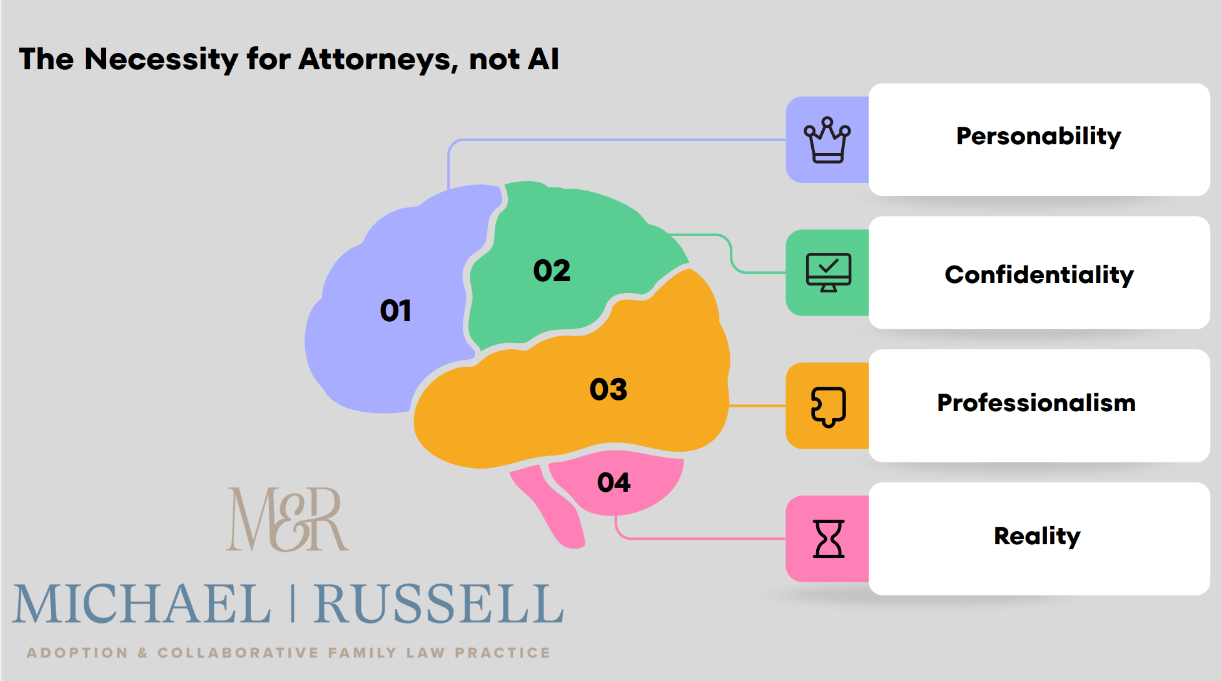
Humans are the direct embodiment of critical thinking skills and emotions that have evolved with them as they take on this challenging world. The Family Law practice is tasked with not only dealing with these heightened emotions in a time of stress and trauma, but they are also tasked with thousands of pages of litigation.
Currently, there is a battle happening behind the scenes of this responsibility. Should Family Law practices continue to integrate more and more Artificial Intelligence (“AI”) in a field that deals with such emotions? Many claim that AI can speed up the intake process and the litigation steps for both the firm and the client by automating emails, calendars, and forms. In theory, allowing AI to comb and sort through the vast amounts of financial records and personal data should free up attorneys to become more personable with their respective clients. However, this can be a blessing and a curse.
Many clients, before they even step foot into a Family Law Firm, feed information about their relationships into a chatbot. For example: “How do I respond to this text message?” “How do I deal with this feeling of jealousy?” “Why is my relationship failing?” AI is not only designed to respond in a way the user wants, but it is designed to make the user feel rational.
Time is being spent affirming potentially dangerous thoughts and feelings regarding your marriage instead of seeking professional counsel. Constantly hearing what you wish to believe is an amazing feeling. For Family Law Attorneys, however, it is dreadful; clients are seeking the help of AI chatbots and actively ignoring years of professional experience. Claims are losing their value every time an AI response is being sent in the place of real emotions.
As famously stated by IBM, “A computer can never be held accountable, therefore a computer must never make a management decision.” At the end of the day, AI is a robot. It is not a friend; it is a company.
In this pivotal timeframe, the courts are also taking their stance regarding AI in law. In the case of Sheerer v. Panas (2026), the courts drew significant attention to the use of AI. Panas, who was representing himself in the case, submitted an appeal riddled with false information and imaginary records. The courts took this as an opportunity to potentially begin an era of important precedents. They ordered strict warnings stating that no party should submit information with citations that have not been independently verified. They also threatened to impose monetary sanctions due to the waste of judicial resources and for the violation of fundamental court rules.
Along these lines, multiple courts have stated that AI does not fall under any sort of confidentiality agreements. Every bit of information fed to AI can be recalled and used by opposing counsel, opening the door wide open for a plethora of new exhibits.
There is no stopping the growth of AI and its involvement in day-to-day life, but there is no question that AI should never replace human judgment and emotions. Here at Michael & Russell, PLLC, we prioritize your feelings and your case. We believe that the best possible solution is one that not only avoids litigation but puts your family first. With decades of professional experience and personal experience, we will carve through the sea of misinformation for you and your family.
Written by Richard Stroup